
There is no number of posts that unlocks Google traffic. A useful page may attract visitors while a larger collection may not. Count published pages for workload planning, not as a ranking threshold.
The more useful question is whether the pages you have can be discovered, answer a real need, and offer something worth reading. Use those checks to decide whether to publish, improve or consolidate.
Check the pages you already have
Make a list of the pages you want indexed. For each one, record its purpose, indexing status, relevant internal links, and any available query data. Use URL Inspection for a specific page and Performance for its search visibility.
Do not assume more writing will solve a site-wide access problem. Conversely, an intentionally excluded duplicate is not a reason to rewrite the main article. Diagnose the correct URL first.
Use the evidence to choose the next task
| What you observe | A useful next action |
|---|---|
| Important pages are excluded | Inspect their reasons before expanding the library. |
| Relevant impressions, but an incomplete answer | Improve the section readers need, with evidence or steps. |
| Two pages answer the same task | Review whether to consolidate, retaining useful material and planning redirects if URLs change. |
| Readers repeatedly ask a distinct question | Research and publish a connected answer if you can serve it well. |
| Too little data to interpret | Review audience needs and technical access; do not invent a trend from a few impressions. |
These decisions use both editorial judgment and data. A lack of reported queries does not by itself prove there is no demand.
Build a connected plan around one problem
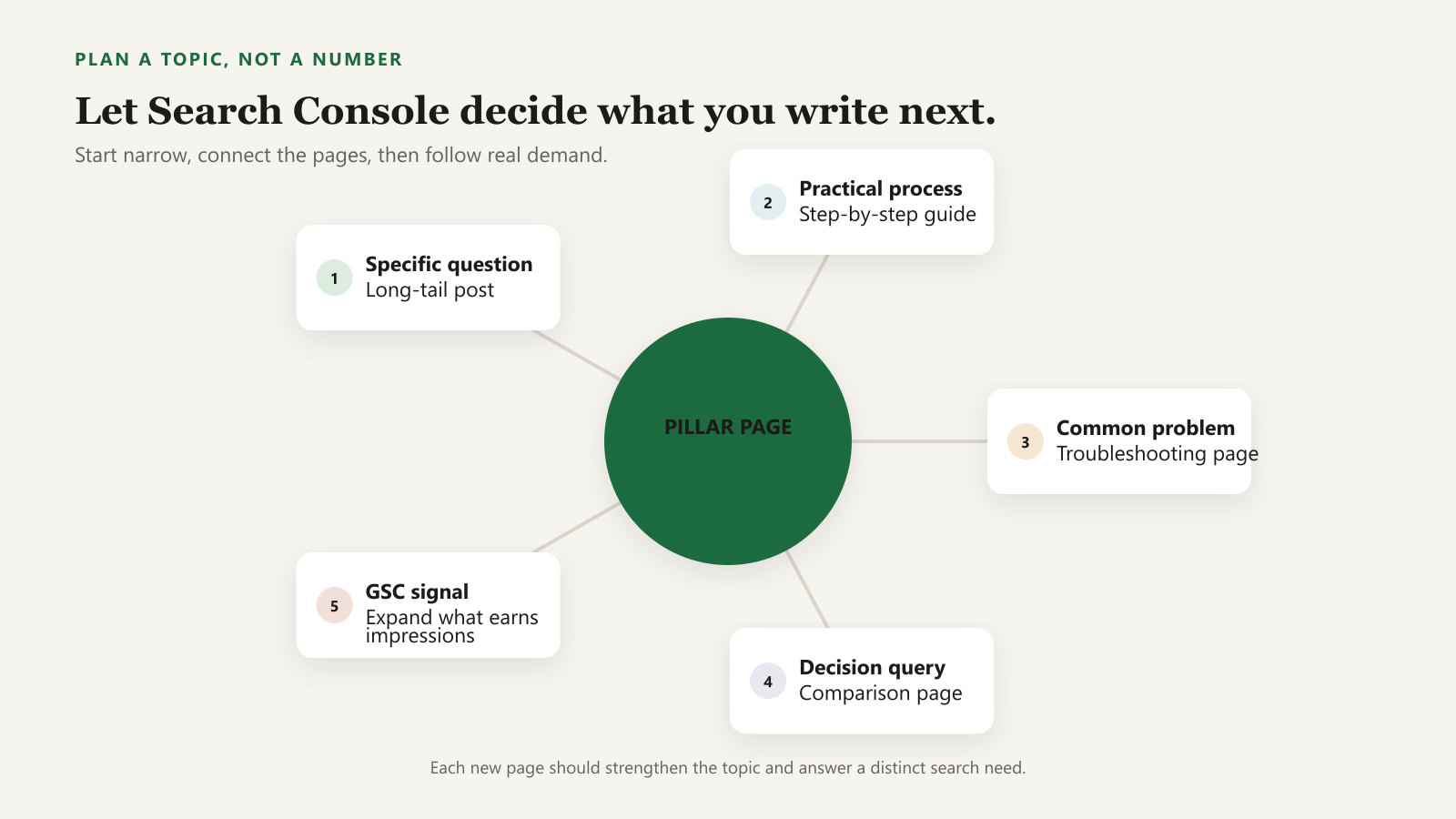
Illustrative content plan: a site about getting new websites discovered might begin with an indexing overview, a URL Inspection walkthrough, a sitemap task and a diagnosis of one specific exclusion. This is a scope example, not a tested formula or a required number of pages.
Each page needs a distinct purpose. Link the overview to the tasks, and link each task back to context. Add a related page when it would help a reader continue, following Google's link guidance. Do not publish separate pages just to create a larger cluster.
Give every page a job
- OverviewExplain the problem and help the reader choose a next step.
- TaskProvide the actual steps and a way to check the result.
- DiagnosisExplain a specific failure and how to investigate it.
Choose a pace you can maintain
Estimate the time needed for research, source checking, writing, illustrations and review. Choose a schedule that leaves time to maintain existing pages. There is no requirement to publish daily or weekly.
Before adding another article, check its brief: whose question is it answering, what evidence will it use, and which existing page should link to it? If those answers are vague, the next useful task may be research rather than publication.
Google explicitly rejects the idea of a preferred word count. Use the detail the task requires, without padding a short answer or cutting steps just to meet a target. See its content quality guidance.
Review a consistent set of pages
Compare the same pages over comparable periods in Search Console. Keep country, device and search type consistent. Newly added pages change the mix, so site-wide average position alone can be misleading.
Write down the questions still unanswered and the changes that would improve usefulness. Use the change-log template to avoid mistaking a busy publishing schedule for demonstrated progress.
A repeatable content review
- InventoryWhat pages exist, and what task does each serve?
- InspectCan they be indexed, and what do readers or query data reveal?
- ChooseUpdate, consolidate, publish or gather more evidence.