
A useful keyword for a new website connects a real audience question with an answer you can provide well. A longer phrase or a low volume estimate does not automatically make it easy to rank.
The process below is a manual research method. It produces a reasoned shortlist, not a guaranteed ranking forecast. Save your evidence so you can revisit the decision when results change.
1. Collect questions from the audience
Start with problems you understand: questions from customers, repeated questions in relevant communities, or tasks you have worked on. Record the wording and context before turning it into a proposed article title.
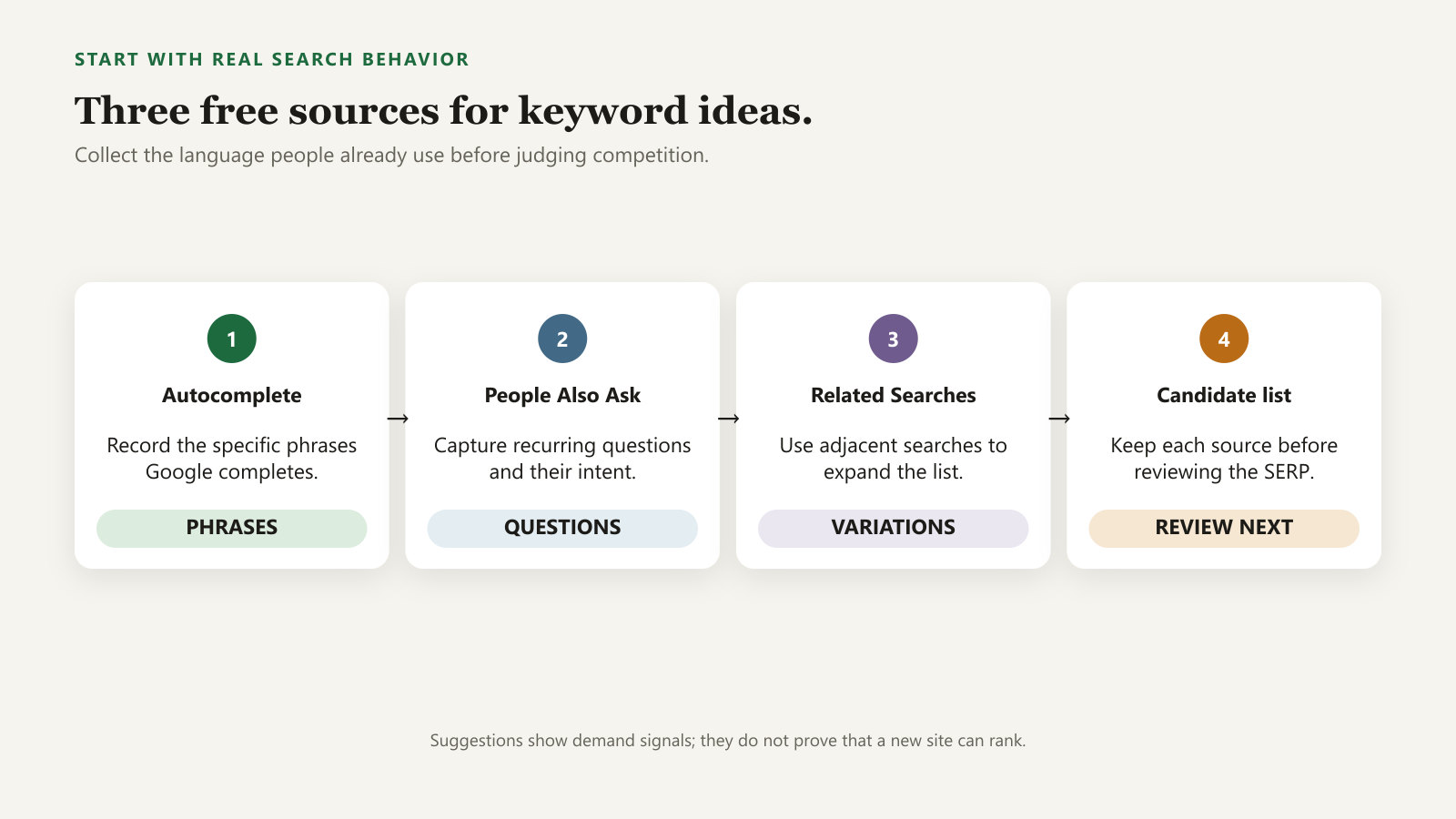
Google autocomplete, related searches and People Also Ask can suggest adjacent questions. Their presence does not tell you monthly volume, and their absence does not prove that nobody needs an answer. On an established site, Search Console's query data can add evidence from actual impressions, subject to reporting limitations.
Write down who needs the answer. A shop owner trying to fix an excluded product page has a different task from a developer researching canonical implementation.
2. Review intent and the competing answers
- Search for the query using the intended language and location. Record the date and device context.
- Identify the main formats: product pages, tools, tutorials, comparisons or discussions.
- Read several relevant results and note what they do well, what is missing, and whether the information is current.
- Decide whether your intended format serves the same task. Do not force an article onto a query that requires a working tool.
A small domain does not prove weak content. A forum may be a strong answer when people want experiences. Avoid treating a count of three blogs or three famous brands as a pass/fail rule.
Record evidence before labeling a query easy
- Audience and intentWho is searching, and what do they want to finish?
- Current answersWhich formats and evidence already serve the task?
- Your contributionWhat useful detail, experience or resource can you add?
3. Use a short decision worksheet
| Field | What to record |
|---|---|
| Question and audience | The task, intended reader and country or language. |
| Evidence of need | A source question, query impressions or other evidence; label any volume estimate. |
| Search context | Review date and the useful result formats. |
| Content gap | A concrete missing answer, not simply a shorter or older page. |
| Your evidence | A tested process, a source, an example or a resource you can provide. |
| Page decision | Create a new page, expand an existing page, or defer the idea. |
If you cannot describe the contribution, revisit the topic before writing. Google's helpful content guidance is useful for reviewing whether an answer adds value; it does not supply a keyword difficulty formula.
4. Group phrases that belong to the same task
“Check if my page is indexed” and “inspect a URL in Search Console” may fit in one walkthrough when the reader needs the same steps. “Crawled, currently not indexed” can require a separate diagnosis once there is enough distinct material to justify it.
Compare both reader needs and the actual results before merging topics. Similar wording is a clue, not proof of identical intent. If a page already answers the task, improve that page and link to it instead of creating a near-copy.
Use the article planning process once the scope is clear.
A hypothetical example: checking an indexed page
Illustrative exercise, not a live search study: imagine you have collected the question “Does Test live URL mean my page is indexed?”
- Need: a beginner is confusing a current fetch test with stored indexing data.
- Evidence to collect: real questions from readers or query data, plus a dated review of current results.
- Possible contribution: explain the two reports side by side and link to Google's definitions.
- Page decision: if your indexing guide already covers the difference, expand that section first.
This example has not established search volume or low competition. It demonstrates how to choose a useful scope without inventing a search-results observation.
Choose the page action
- Same task already coveredImprove the existing answer and make it easier to find.
- Distinct, useful taskCreate a connected page when you have enough evidence and detail.
- Unclear need or contributionKeep researching rather than publishing a thin variation.