
For most small business websites, I’d publish two useful blog posts a month. If you have a writer, an editor, and enough firsthand knowledge to keep the work sharp, make it four. I wouldn’t start with daily publishing.
Why two? It gives a small team enough room to research a topic, say something specific, and connect each article to the rest of the site. Do that for a year and you have 24 purposeful pages. Rush out 24 posts in a month and you may have 24 pages you’ll need to fix later.
That’s my answer to how often to blog for SEO. Once you’ve chosen a frequency, the question is what those posts will help you become known for.
Start with two posts a month, then earn a faster schedule
A new blog needs a publishing schedule it can actually keep. Two posts a month is a solid default because each post still needs work after the draft is finished: fact-checking, images, internal links, and a final read from someone who knows the subject.
If you can do all that weekly, publish four. If one article requires interviews, original data, or hands-on testing, publish one. That’s a sensible trade.
What I wouldn’t do is set a weekly target because a competitor publishes weekly. You can see their output. You can’t see how much they spend, how many pages they later remove, or whether those pages bring in customers.
For most business blogs, I’d plan the first six months around a narrow set of topics. Say you run accounting software for small restaurants. Six articles about restaurant cash flow, inventory costs, and payroll can work together. Six articles about unrelated small business trends? Less useful, even if each one targets a keyword.
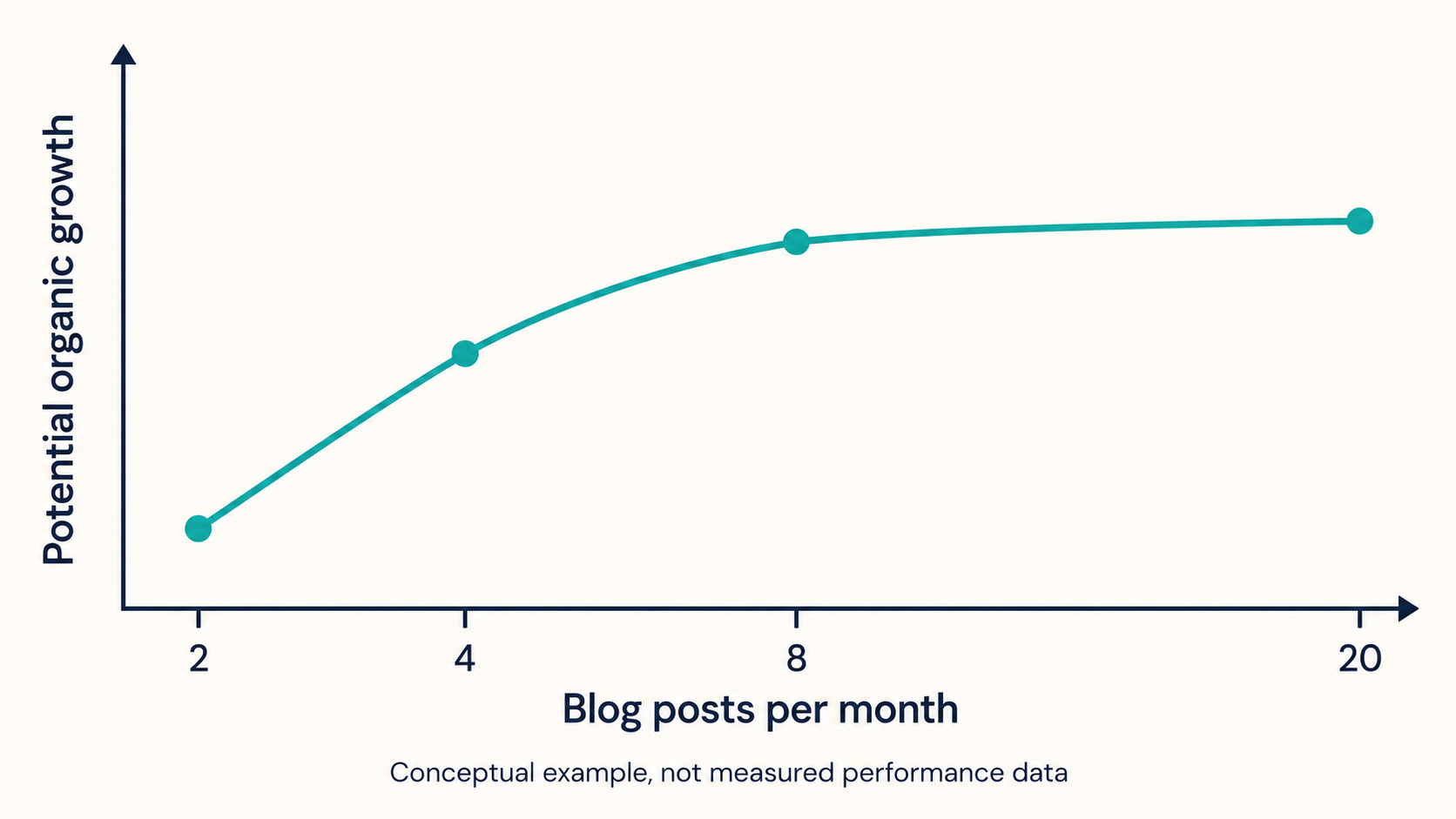
Publishing frequency isn’t a ranking factor
Let’s get the biggest myth out of the way. Google doesn’t give your site a bonus for publishing every Tuesday.
But frequency can change what your site offers. More well-planned posts let you answer more relevant questions. They give other pages something useful to link to. They give you more chances to learn which queries bring in the right visitors. That’s the actual mechanism.
A regular cadence may also affect how often Google discovers changes on your site. Google says crawl demand can vary with factors including a site’s update frequency, page quality, and relevance. But crawling is only the first step. A page can be crawled and still fail to earn a useful place in search results. Google’s crawl budget guidance is mainly useful when a site has a large or complicated collection of URLs.
Look, if your blog has 40 articles and your newest post isn’t ranking, crawl budget probably isn’t the fire to put out. Check whether Google can index the page. Then read the search results for its target query. Does your article answer the same need, with something the ranking pages don’t provide? Can a visitor reach it through a relevant link on your site?
I’d look there before asking a writer to publish twice as often.
Freshness matters when the query calls for it
Some searches demand a recent answer. “Best payroll software in 2026” might. “How to calculate payroll tax” may need current rules. Breaking news certainly does.
Google describes “query deserves freshness” systems that show newer material when people are likely to expect it. The important part is when people are likely to expect it. A tutorial on cleaning a cast-iron pan doesn’t become unhelpful at midnight on December 31.
This is where a lot of blogging frequency advice goes wrong. It treats every topic as if an older publication date were a defect.
I’ve made that mistake. I used to put too much weight on the date at the top of an article. Then I’d open the page and find that the explanation was sound, the examples still worked, and readers had no reason to need a new version. Changing the date wouldn’t improve a thing.
Other pages do need attention. A software tutorial with old screenshots. A pricing guide with figures from three years ago. A comparison that omits a major new option. That’s content decay you can address. And often, a careful refresh is a better use of a writing day than another new URL.
So before you add an article to next month’s calendar, ask whether an existing page already serves that topic. If it does, improve that page.
Your topic map may be the real bottleneck
Four disconnected articles? Often worth less than two that feed the same cluster.
Imagine a local bookkeeping firm publishing posts on remote work, Instagram captions, business insurance, and invoicing. Each topic is relevant to some small business owner. Together, though, they tell neither a reader nor a search engine much about the firm’s particular expertise.
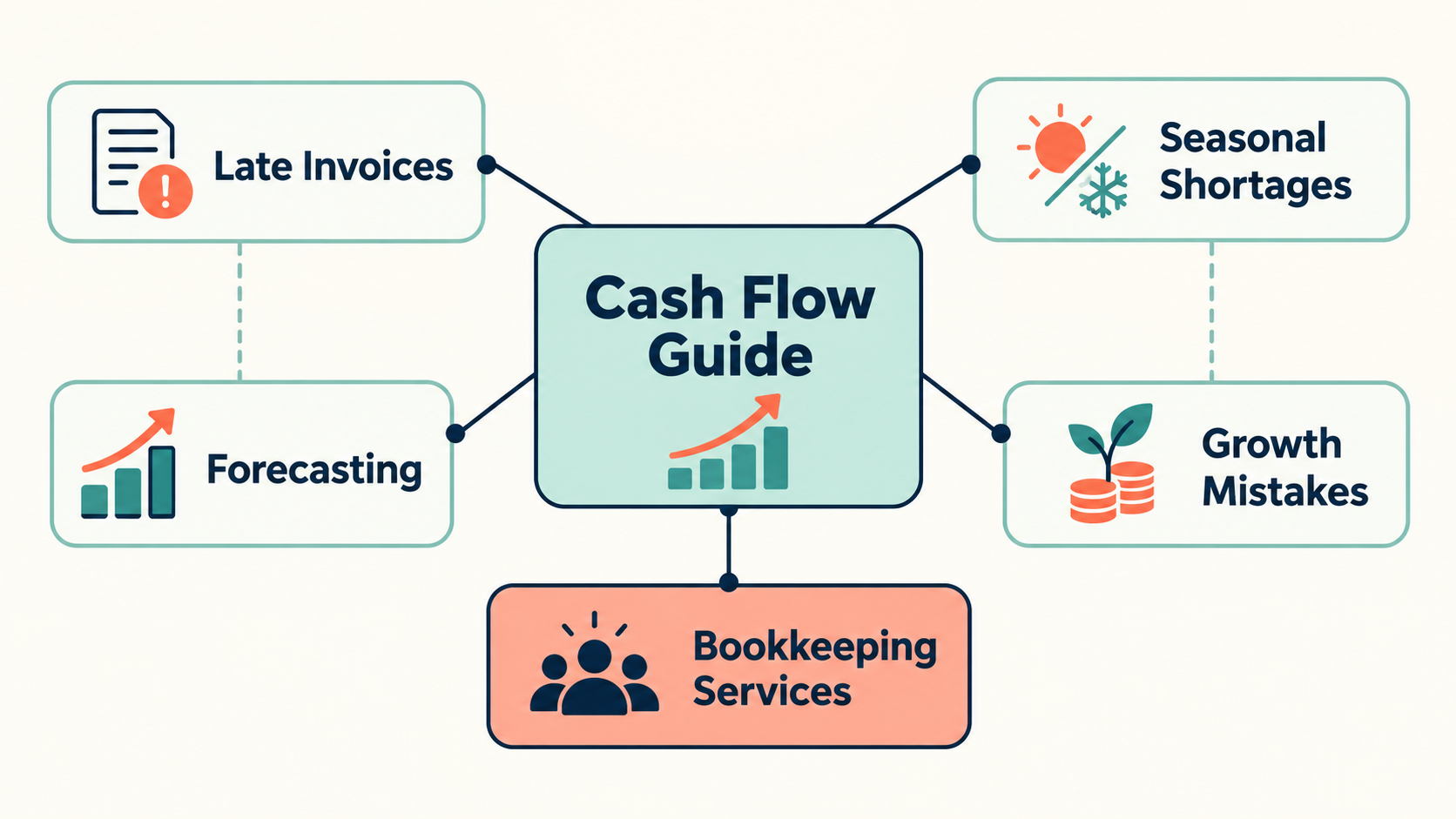
Now give that firm a tighter plan. One guide to cash flow forecasting for service businesses. Then articles on late invoices, seasonal cash shortages, forecasting from uneven revenue, and cash flow mistakes during growth. Link them where the reader would naturally want the next answer. Link relevant articles to the firm’s bookkeeping service page, too.
That’s a topical cluster in practical terms: connected pages that help someone work through a subject. You don’t need to draw an elaborate diagram before you write. You do need to know where a new post belongs. See how many blog posts to plan when building a connected set.
Before I’d approve a topic, I’d want three answers:
- Which reader problem does this page solve?
- Which existing page will link to it?
- What should the reader understand or do next?
If those answers are fuzzy, increasing your blogging frequency will probably make the site harder to maintain.
Daily AI posts can create a cleanup job
AI can help you organize notes, compare outline options, or spot an explanation you’ve left unclear. I use those tasks as a test: can a tool save time while the writer still supplies the knowledge?
When a site uses AI to produce a new article every day from brief keyword prompts, the failure mode is predictable. Several pages answer nearly the same question. Examples stay vague. Facts go unchecked. The blog grows, but choosing which page to improve becomes harder.
Google’s guidance on helpful, reliable content asks creators to examine whether their work offers original information or analysis and whether extensive automation is being used to attract search traffic. Its former Helpful Content system became part of Google’s core ranking systems in 2024; there isn’t a separate switch that marks every AI-assisted article as bad. Google also has a scaled content abuse policy aimed at large amounts of content made primarily to manipulate rankings.
That distinction matters. A carefully edited article isn’t disqualified because AI helped with an outline. A hundred near-duplicate pages don’t become useful because a human changed a few words.
Honestly, burnout is what catches many teams first. Someone has to check those pages later. Someone has to notice when they overlap, break, or become outdated. If your publishing pace leaves no time for that work, the pace is too high.
My recommendation by scenario
Use these numbers as a starting schedule. Review them after you have enough search and business data to see what the content is doing.
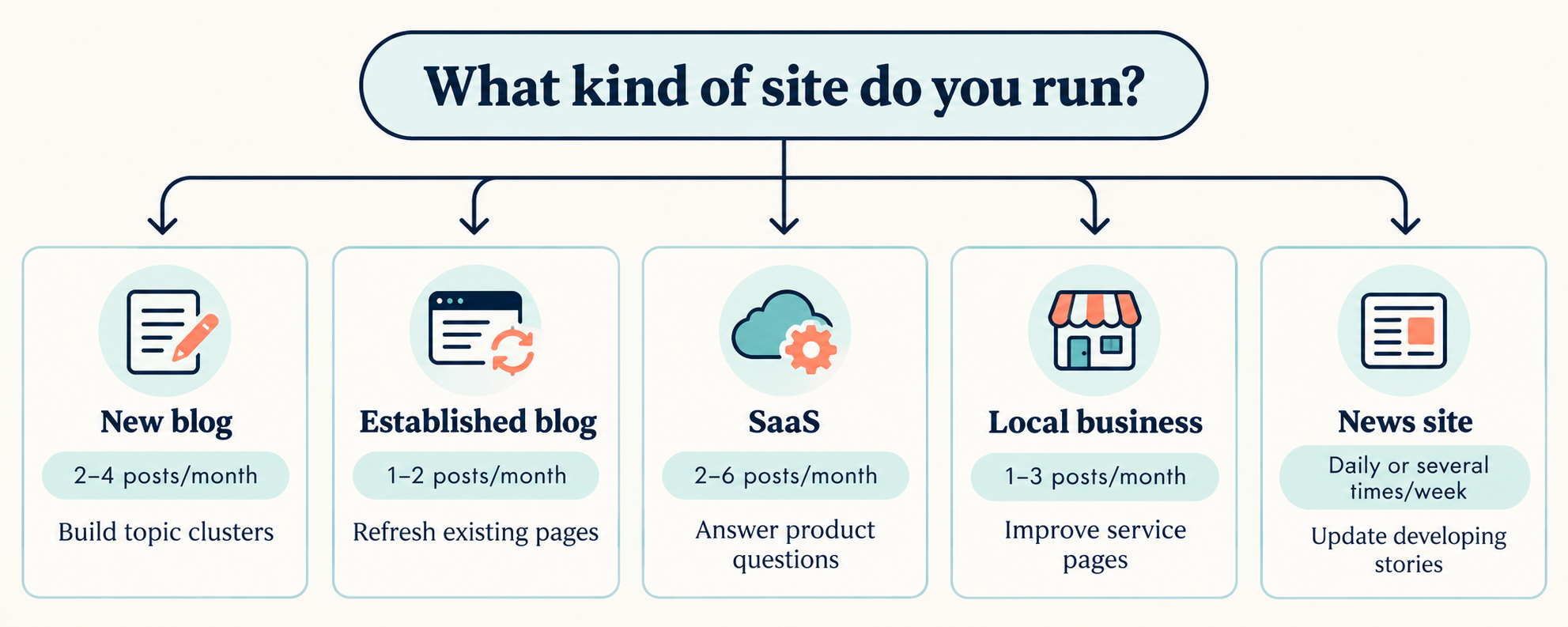
| Website | New posts | Where I’d spend the remaining time |
|---|---|---|
| New blog | 2–4 per month | Build two or three focused topical clusters and link the pages |
| Established business blog | 1–2 per month | Refresh pages with declining traffic or clear ranking potential |
| SaaS site | 2–6 per month | Cover product-related problems with input from customers and product specialists |
| Local business | 1–3 per month | Improve service pages and answer specific local customer questions |
| News site | Daily or several times a week | Report accurately, update developing stories, and correct errors |
New blog
I’d begin at two posts per month. Move to four only after you’ve published enough to know that your research, editing, and linking process holds up. Twelve strong posts in six months gives you something to assess.
Pick a couple of related subjects. Stay with them long enough to answer the obvious questions and the awkward, specific ones competitors skip.
Established business blog
The archive is an asset. Use it.
Articles getting impressions but sitting below the top results? Give those a look before you commission another batch. One revised page with a better answer, clearer examples, and useful internal links may be a better project than two brand-new posts.
SaaS
The right pace depends partly on how many distinct customer problems the product addresses. A broad platform may support six useful posts a month. A narrow product might be better served by two excellent guides, a comparison page, and stronger product documentation.
Ask your support and sales teams what customers struggle to understand. That conversation can produce better topics than another export from a keyword tool.
Local business
I’d be suspicious of a proposal for 20 generic blog posts a month. Customers usually need clear service information, prices or pricing factors, preparation advice, and answers specific to their area. Start there.
If you can answer one question each month that your staff hears repeatedly, you already have a useful content plan.
News site
Recency is part of the reader’s need, so frequent publishing makes sense. Daily, sometimes more. Speed still needs reporting behind it, and developing stories need updates and corrections when the facts change.
Publish new or refresh old?
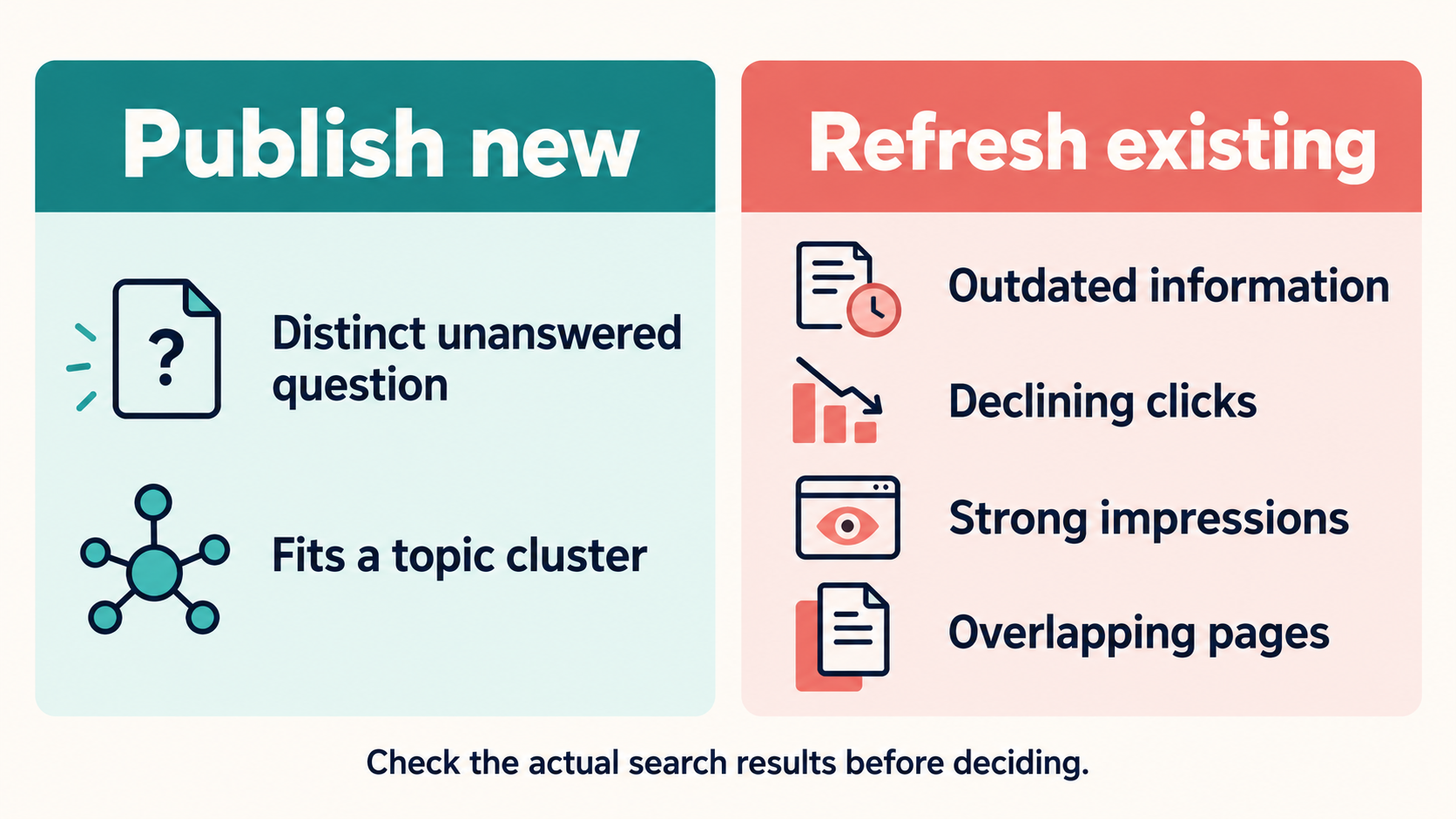
Here’s the rule I use: publish a new page when there’s a distinct reader need your site doesn’t answer. Refresh an existing page when it already answers that need but could do the job better.
Search Console is where I start. Not for the “average position” number — for the queries. Which searches produce impressions? Are those the searches the page was meant to answer? Has the page started losing clicks for a query it used to serve well?
Then I’d read the page and the current search results. The numbers point you toward a page; they don’t tell you what to rewrite.
Average position alone can fool you. It combines different queries, locations, and devices. A page at “position 12” might be close to winning an important query. Or most of its impressions might come from searches that will never bring you a customer.
Once you’ve chosen a page, be specific about the repair. Replace outdated screenshots. Add the missing calculation. Explain a step readers keep asking about. Remove a section that no longer belongs. If two posts serve the same intent, consider combining their useful material into one stronger page.
And please don’t change the publication date and call that a refresh. Readers can tell.
How soon should you expect results?
Realistically? On a new site publishing two to four focused posts a month, I’d check for early impressions around months three and four. I’d use months six through nine to judge whether organic traffic is becoming useful.
Those are planning checkpoints, not promises. A site targeting hard national queries may take longer. A business answering specific, underserved questions may see traction earlier. Search Console impressions also aren’t the same thing as visitors, and visitors aren’t the same thing as leads.
At month three, I’d ask: are the pages indexed, and which queries are they appearing for? At month six: are any pages gaining clicks, and are the queries relevant to the business? At month nine: which clusters show promise, and which ones need a change in direction?
Twelve months in with almost no impressions across a substantial set of published pages? Don’t quietly raise the target from four posts to eight. Audit the basics. Check indexing and internal links. Read the results for the queries you chose. You may have picked topics too broad for a new site, written for a different intent, or published pages that say little beyond what already ranks.
I’d rather discover that after 20 posts than after 100.
Keep the schedule you can improve
Start with two posts a month if you’re a small business building a blog. Give each one a clear reader, a place among related pages, and enough time for proper editing. Increase the pace when the process can support it.
Then keep looking back. The article you improve next month may do more for your SEO than the one you were about to write.