
A potential customer asks ChatGPT or Claude to recommend three service providers. The assistant names three companies. Yours isn’t among them.
That missed opportunity may never appear in your reports. There’s no query in Google Search Console, no ranking to investigate, and no visit to trace. You can see how your website performs in Google, but that tells you little about whether an AI assistant considers your business worth recommending.
In my SEO work, this is a gap I’m paying closer attention to. GEO, or generative engine optimization, means improving visibility in AI-generated answers. I see much of it as familiar SEO work: useful pages, technical accessibility, and a credible reputation. We also need to look at how third-party sources describe the business.
What brand mentions tell us about AI visibility
My first response to this problem was familiar: improve the website, publish better content, fix technical issues, and earn more backlinks.
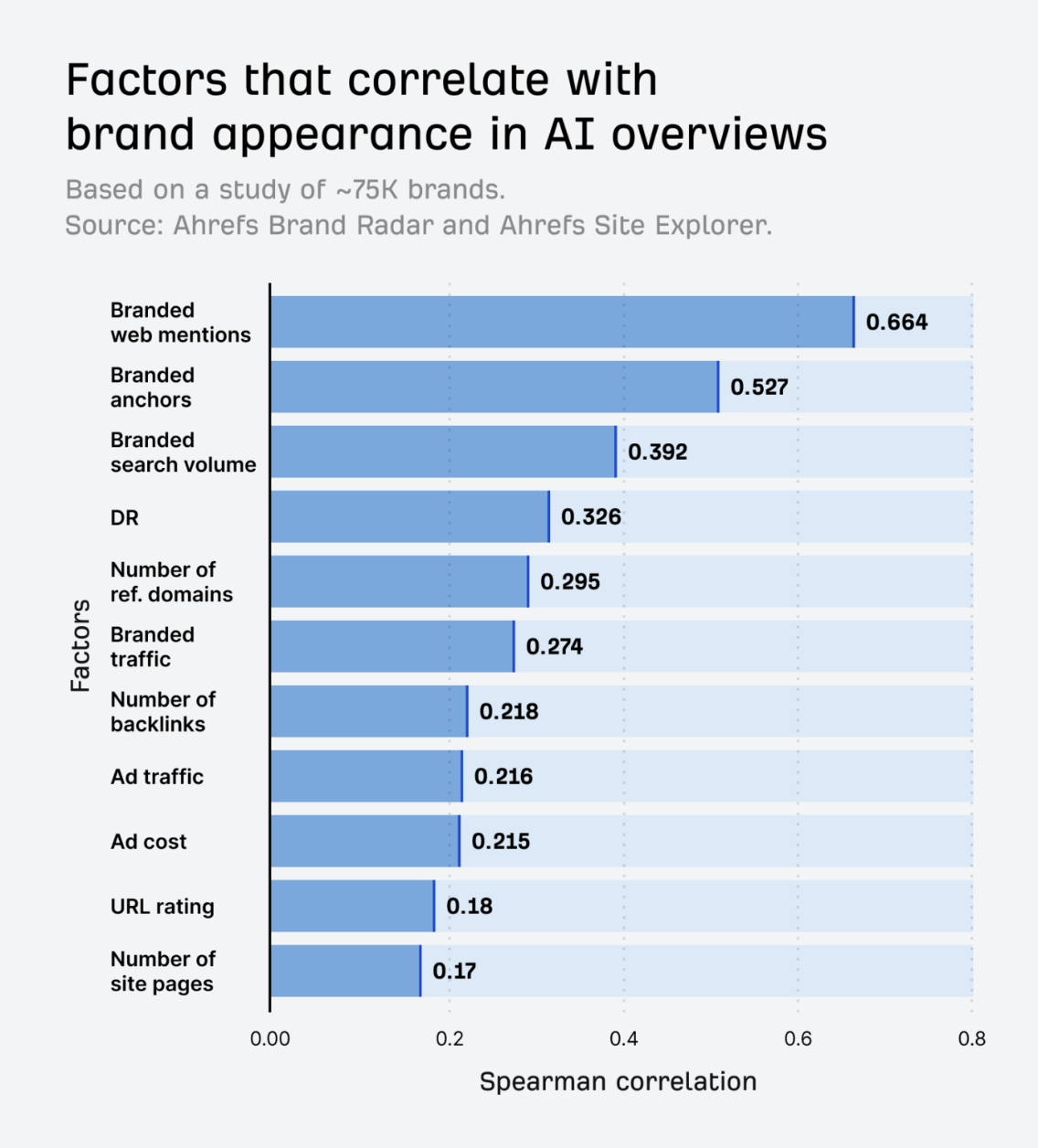
Then I looked at Ahrefs’ research covering 75,000 brands. In its AI Overview study, the correlation between brand mentions across the web and brand visibility was 0.664, compared with 0.218 for backlinks—roughly three times as high.
Correlation doesn’t prove causation, but these figures give me a reason to look beyond the assets we control.
SEO teams spend considerable time on pages, site architecture, links, and rankings. That work remains useful. But if customers ask AI which company to hire, we also need to understand what independent sources say about us.
My reading of the research is that third-party discussion deserves more attention in an AI visibility strategy.
A ranking and a recommendation serve different purposes
In traditional search, we create a page, make it accessible, match it to a relevant query, and compete for a position. A searcher sees the result and decides whether to click.
AI discovery adds another layer. Large language models learn from substantial amounts of text, including information about companies, products, and public discussions. Systems with live search or retrieval can also consult sources when answering a question.
A company’s website is part of that information environment. So are:
- Industry publications and third-party articles
- Reddit threads and other forum discussions
- Independent reviews and comparisons
- YouTube videos and accessible transcripts
- Expert recommendations
A mention doesn’t necessarily need a hyperlink to describe what a company does or why someone trusts it. A forum comment about reliability or a comparison explaining a product’s strengths can provide context beyond the company’s own claims.
That doesn’t mean every mention will be retrieved or influence an answer. It means counting backlinks alone leaves out information that may shape how a brand is represented.
This is why I’m revisiting digital PR and reputation work. Alongside asking how to rank a page, I’m asking whether credible sources give someone enough reason to recommend the business behind it.
Traditional SEO still provides a foundation
It would be easy to take this argument too far and move the entire budget into PR and brand mentions. I wouldn’t do that.
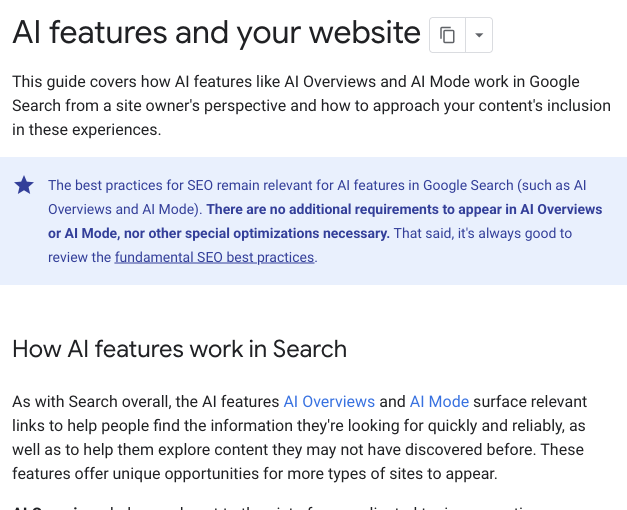
One dataset I examined suggested that 76.1% of sources cited in AI-generated answers came from pages ranking in the top 10 search results. That finding needs to be understood within its dataset; it isn’t a universal rule for every assistant or industry. Still, it shows why search visibility remains relevant.
AI systems that use web search need discoverable sources. Pages that already perform well in search can overlap with the material those systems retrieve and cite.
There is a useful distinction here: a strong ranking can help a page become a source, while credible coverage can help establish why a brand belongs in a recommendation. A well-ranked informational article doesn’t automatically make its publisher a recommended service provider.
If you’re starting from scratch, my guide to How to start SEO for a new website covers the same foundations: technical accessibility, useful content, and questions the site can answer well. For keyword research, the guide to low competitive keywords explains how to assess whether existing results leave room for a useful contribution.
I would also consider how the business is described beyond its own domain. Traditional SEO gives us a foundation to build on; it doesn’t cover every part of AI discovery.
Write information people can use
Testing different content formats has made me more critical of corporate copy that sounds polished but says little.
Consider this illustrative example:
“We provide comprehensive, end-to-end website development solutions for international businesses. Leveraging our extensive technical expertise and industry experience, we empower brands to accelerate digital transformation and expand into global markets.”
A reader still doesn’t know which capabilities the company offers or how to evaluate them. An assistant has little specific information to extract, either.
A buyer’s guide serves a different purpose, but this example shows what more specific information looks like:
“When choosing an e-commerce website builder, evaluate three essential capabilities:
- Native support for payment gateways such as PayPal and Stripe.
- Website performance that meets Google’s Core Web Vitals standards.
- Built-in multi-currency support, including automatic currency conversion.
Missing any of these capabilities can create additional operational costs and conversion challenges as the business expands internationally.”
The second passage gives the reader concrete criteria. Its individual points are understandable without the rest of the article, making them easier to summarize, compare, or cite.
Clear definitions, specific facts, and useful explanations make content easier to work with. That doesn’t require turning every article into a checklist. The aim is to give each paragraph something useful to say.
Where I’m putting more effort
Three areas now receive more of my attention alongside the usual SEO work.
Answering questions in relevant communities
I’m focusing on specific questions in Reddit threads, niche forums, and industry communities.
The value comes from helping someone solve a problem. A brand reference belongs where it explains the answer and where disclosure requirements and community rules permit it.
Manufactured recommendations offer little reason for anyone to trust the business. Useful contributions give people something they can judge for themselves.
Publishing educational videos
A useful three-minute walkthrough can communicate more expertise than ten generic promotional articles. When its transcript is accessible, the spoken explanation can also become searchable and potentially retrievable.
For example:
“I typically use [Brand Name] to handle this part of the workflow because it supports [specific capability].”
That sentence explains the product’s role and why it fits the task. Repeating a brand name without that context adds much less.
Maintaining clear documentation
Official documentation should make basic questions easy to answer: what the company does, what it offers, who it serves, and how it differs from similarly named businesses.
Consistent information across official pages and credible third-party sources can help AI systems distinguish the company from unrelated entities. It also gives customers a clearer understanding of what they are considering.
Outdated information can reach customers before you do
Being left out of recommendations is one concern. Being recommended with the wrong information is another.
Recently, a customer asked whether we still offered a basic package for 199 yuan. We had discontinued it two years earlier.
I traced the price to a media review published three years ago. Our website had already been updated, but the old review was still circulating.
AI systems can sometimes identify outdated information, especially when they retrieve recent sources. They don’t always resolve conflicting accounts correctly. An old review may still surface, carrying a discontinued price, feature, or service description into a customer’s first interaction with the business.
Updating the website is necessary, but it may leave the original source untouched. In this case, the useful questions are practical:
- Can the publisher correct the old article?
- Can the review be updated to reflect the current offering?
- Is there a clear, current source that documents the change?
- Does the official pricing or product page show an explicit revision date?
This is familiar reputation management work with another audience to consider. We need accurate information for customers and for the systems that may retrieve and repeat it.
Traffic reports show only part of the change
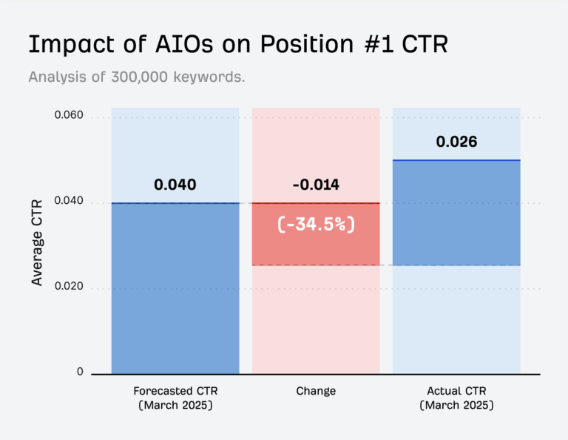
Some industry studies have reported zero-click search rates rising from 56% to 69% over a one-year period. Ahrefs’ April 2025 research suggested that AI Overviews could reduce the organic click-through rate of the top-ranking result by approximately 34.5%.
The exact effect depends on the dataset, query type, market, and definition of a zero-click search. I wouldn’t apply those percentages directly to every website or treat an older study as a current forecast.
They do point to a change worth investigating: users can get an answer without visiting the source. As assistants become part of research and purchasing decisions, a website visit captures only part of that process.
Since ChatGPT’s release in late 2022, the technology has developed quickly. Our ability to measure brand discovery across assistants is less complete.
We don’t have a universally accepted AI ranking report or reliable keyword-level impression data across every major assistant. We also lack a complete view of how often a brand is considered but omitted from an answer. Those gaps make it harder to diagnose missed opportunities.
What I’m changing in my approach
I’m continuing the SEO work that makes pages useful and discoverable. Alongside it, I’m paying closer attention to credible third-party coverage and keeping information about the business accurate wherever it appears.
I don’t expect a larger volume of content or thousands of low-quality mentions to solve this problem. I want better evidence of what the business does and why someone would choose it.
I still care about where a page ranks on Google. I also want to know what happens when a customer asks an assistant:
“Can you recommend three reliable service providers for my business?”
Will it have enough accurate, credible information to include us?